The return of the Halmore Hobbies

by Chris Newton.

A year ago I gave an account of a successful breeding attempt by a pair of Hobbies on farmland near my home in Halmore, Berkeley. I thought those who have seen that article would be interested in hearing what happened in 2021.

Last year my final sighting of one of the adult birds was on September 17, and I last saw the two juveniles on the 22nd, by which time they were fully grown and strong flyers. Having kept my fingers firmly crossed over the winter for a return, I was delighted, on May 1 this year, to spot a Hobby on Ragged Oak (as I call it), the stag-headed oak tree amid arable farmland which was most frequently used by the Hobbies in 2020, first by the male while on lookout and later also by the juveniles after fledging. This 2021 arrival was even on the same branch, suggesting that I was looking at the same male bird.

The male hobby in late June 2021 on ‘Lone Oak’, taken from a hide concealed in a nearby hedge (Chris Newton)

Within the hour we were leaving for a two-week holiday in Scotland, so I could do no more until the middle of May. I was conscious that after 2021’s very cold spring the bird world generally was a couple of weeks behind the norm, and that the small birds upon which Hobby families rely were in short supply, Would this affect breeding?

Sightings from mid-May to mid-June were irregular and always of single birds, but then on June 15 I spotted two Hobbies sitting in the birds’ other favourite tree, a solitary oak tree I call Lone Oak. From my previous observations, they were behaving typically for a mated pair pre-incubation – sitting several feet apart in the same tree and doing very little for extended periods. I saw them again later that day and the next, but after that we were back to single-bird sightings for the rest of the month. I presumed that this was because the female was now on eggs, which are typically laid around mid-June, although I was conscious that given the late spring, the breeding cycle might have been pushed back.

The male soaring above (Chris Newton)

On 13.7 I saw one of the birds, presumably the male, apparently chasing away a Kestrel (a Kestrel pair were successfully raising a family in the same area at about the same time). A couple of days later I saw the Hobby harrying a small group of Swallows high up (Swallows and other hirundines were thin on the ground locally this summer, so perhaps he was having to take every chance he could get). Then on July 16th I was surprised to see two Hobbies flying away together from the field side by side. I had assumed the female must be incubating, although I believe female Hobbies do leave the nest periodically.

During the second half of July, when the temperature topped 30 degrees, and the first half of August, I continued to make sporadic sightings of single birds, always in mature oaks with bare branches, like last year. However these locations were not all in or around the birds’ ‘home’ field as they had been in 2020, and some of the chosen trees were 200-300 metres away from the group of oaks where I had presumed the Hobbies were nesting, making me wonder if they had chosen another location.
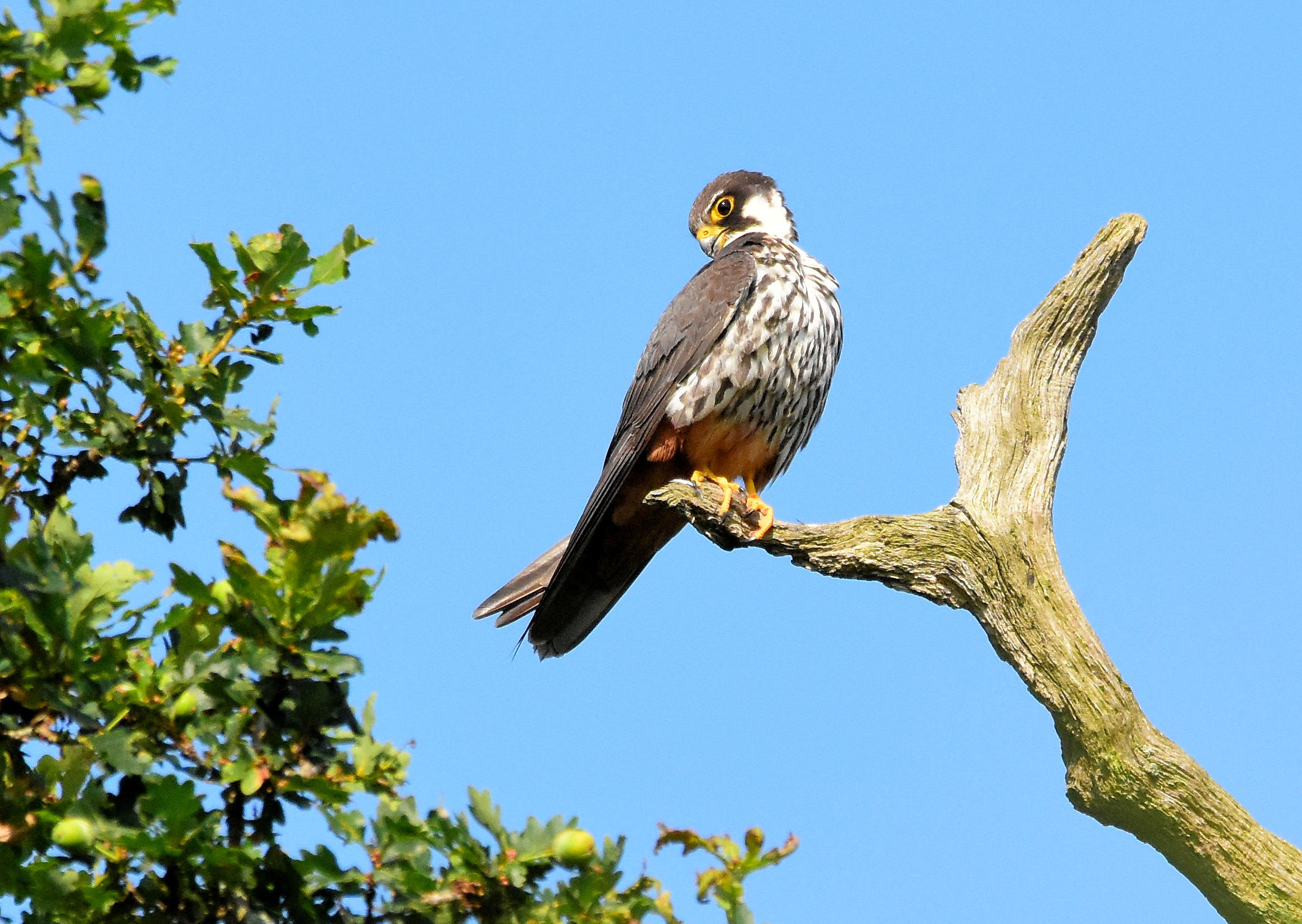
A view of the bird on ‘Ragged Oak’ (Chris Newton)

On August 11, I noticed from afar a commotion in the heart of the Hobbies’ territory which involved two Hobbies and a number of Carrion Crows. The crows did not seem willing to leave, and the fuss went on for several minutes. Was this an attack on the nest, and if so was this, or another attack by these birds, successful? I will never know, but it seems possible.

I was now searching daily for branching juveniles, as in 2020 I had first seen them on August 16. I was also still hoping to see or hear a food delivery, something which I had observed several times by the same stage of the 2020 season, because this would have given me a fix on where the nest actually was. In fact I only ever detected one food delivery, on August 14, when I heard the male’s ‘burglar alarm’ call and saw him bringing a food item into the same small group of large oaks where I believe they nested last year, suggesting that young birds were still being fed at that point – although he may of course have been provisioning the female. I heard that unmistakeable call many times last year, but in summer 2021 I heard it only three or four times in total.

Solitary bird photographed in late July (Chris Newton)

I saw single Hobbies several times from then until August 30, when a glimpse of the male in Lone Oak proved to be the last sighting of the summer. I continued to patrol the area with binoculars until the end of September without further success. I also explored our local fields more widely, conscious that other pairs might be breeding nearby (I have anecdotal evidence from a neighbour that they have nested in the area before) and if so, that the August-September period would give by far the best chance of discovery, because this is when the whole family are on the wing as the juveniles learn to fly and to hunt.

So was predation the cause of this year’s failed attempt to breed, or was it the lack of food in the shape of small (and particularly young) birds? Or maybe something else? I will never know. I am just hoping that my Hobbies will survive the rigours of migration to return in 2022, or perhaps that the chicks they raised last year will return as breeding adults, as they will be old enough then. I’ll keep you posted.

Chris Newton.

Christ Church Peregrines Update

Many thanks to Dave Pearce for updating his chronicles of the Peregrines of Christ Church since 2010. The revised document is now available to download here. Dave is already looking forward to the coming season as we look forward to hearing his insightful observations.

Goshawk Monitoring Project

Members of the Gloucestershire Raptor Monitoring Group (GRMG) have been monitoring the county’s Goshawk population for over 20 years, gathering a wealth of information on the distribution of breeding pairs, timing of breeding and productivity. The Goshawk’s secretive lifestyle has, however, limited the number of ringing recoveries to a handful of records of dead and injured birds during this time. In 2017, we sought to address this by starting a colour ringing project, coupled with the use of trail cameras at nests and baited winter sites to re-sight ringed birds. In the four breeding seasons that have followed, 312 Goshawk chicks have been colour-ringed in Gloucestershire and adjacent counties from 142 successful nests. This is a significant proportion of those ringed nationally.

Read what we’ve learnt and what comes next (PDF).

A collaboration for Cirencester Peregrines

GRMG, Raptor Aid and Cirencester Wildlife Group collaboration to install a Peregrine nest box on the roof of St John the Baptist Church, Cirencester.

We are delighted to report that on 18 December 2020 this Peregrine nest box was installed by Raptor Aid in conjunction with GRMG, the Cirencester Wildlife Group and St John the Baptist Church, Cirencester.

GRMG take this opportunity to thank all associated with this project and in particular for the enthusiasm shown by Cirencester Wildlife Group and the church itself.

Cirencester Wildlife Group have set-up a Go Fund Me page for a nest box camera for internet streaming and their target is £1600. If of interest GRMG would be delighted if our supporters might consider donating towards our first ever Gloucestershire Peregrine internet streaming site at the following link;

https://gf.me/u/zcthff

We would also be extremely grateful if you might share this link with other interested parties.
See project timeline below;
On 7th October 2020 the following article was published in the local press;
Cirencester Peregrine Project aims to provide rare viewings
By Joseph Forte (Reporter)

The Cirencester Wildlife Group will shortly be exploring community grants as well as other funding options so locals can have an opportunity to take a detailed look at Peregrine falcons. 

Prior to 2020, peregrine sightings in Cirencester were mainly a winter affair, with birds seen circling and occasionally perching on the Parish Church of St. John the Baptist. However, at the end of 2019 sightings started to increase – with one bird even seen calling from the top of the church tower at 8am on Christmas Day.

Reports continued at the start of this year, until Dr Ian Grange (senior Environmental lecturer at The Royal Agricultural University) photographed a pair of peregrines on the church tower during the breeding season.

Those involved with the Cirencester Peregrine Project would later learn that church vergers had also witnessed evidence of nesting activity on the tower.

Sadly, whist sightings continue to be frequent, there has been no evidence of chicks successfully fledging. Which is why a collaborative project is now aiming to give these birds an additional helping hand by providing a suitable nest site and allowing researchers and the public an intimate glimpse of their nesting behaviour.

Historically peregrine falcons have not had it easy. In the post-war period of late fifties and early sixties the environmental impacts of chlorinated hydrocarbons were poorly understood.

Whilst BTO scientists (led by Derek Ratcliffe) were researching the effects of these agricultural pesticides, Rachel Carson’s (1962) classic book Silent Spring brought the issue into the public spotlight.

As well as increasing raptor mortality rates, scientists showed that DDT and other organochlorines caused the thinning of egg shells, which broke during incubation, resulting in the serious decline of raptor populations. The peregrine was fast becoming a rare species all over the country.

These enigmatic birds are still regarded as being of conservation concern in both a European and a UK context, however after suffering at the hands of man for many years, this top predator is now benefiting from protection.

As the population recovers, nesting in urban areas has increased in recent years, with more of these birds moving into our towns and cities, they now epitomise a renewed potential for urban rewilding and our ability to live side by side with nature.

Nest sites in the natural environment, known as eyries, are usually located on grassy or earthen cliff-ledges, quarries or other inaccessible undisturbed locations. However, to a Peregrine, an urban environment bears a surprising similarity to canyons and cliffs, with tall vantage points and the added advantage of artificial light which allows these supreme and adaptable hunters to hunt by day and night. As part of the Cirencester Peregrine Project, Gloucestershire Raptor Monitoring Group will be working with Raptor Aid to construct a suitable nest box, which will be installed later this year.

Peregrines typically lay between 3 and 4 eggs in late March and April, which are incubated by both parents until early May. After hatching, the young chicks are brooded by the female for 2 to 3 weeks while the male brings in food. Once fully fledged the parents will then teach the youngsters to hunt and handle prey in flight – a spectacular sight for all those lucky enough to witness.

Excitingly, the nest box will also incorporate the provision for a camera attachment, which it’s hoped will allow ornithologists, peregrine enthusiasts and the general public an opportunity to take a detailed look at the nesting behaviour and ecology of these charismatic birds of prey.

Since peregrines pair for life, typically living on average for between 5 to 6 years and staying on a territory all year round, it’s also hoped that these birds will become a much-loved addition to Cirencester’s community.

If you would like to find out more about the Gloucestershire Raptor Monitoring Group please visit www.glosraptors.co.uk or follow the group’s activities on Twitter via @glosraptors.

If you would like to find out more about the Raptor Aid please visit www.raptoraid.co.uk or follow their activities on Twitter via @raptor_jimmi

Thank you and Season’s Greetings to all our supporters and volunteers.

GRMG team

19 December 2020

Summer of the Hobbies

Many thanks to Chris Newton for sending in his story of how the summer of 2020 gave him a passionate interest in the Hobby. Chris’s excellent observations from close to his Severnside home covers the entire season from the establishing of a territory to return migration, and his notes are accompanied by some superb images.

Read Chris’s article here (PDF).

Christ Church Peregrines news

Many thanks to Dave Pearce for providing this update on the Christ Church Peregrines. A fantastic series of images illustrate a successful year for these birds.

Goshawk update

On the weekend of June 13th/14th some of the ringing and climbing team members of the GRMG went out around Gloucestershire to ring and collected biometric data for Goshawks following the ease to lockdown restrictions by the UK Government. Working in in teams of three and maintaining social distancing at all times, the GRMG visited nests that were previously observed as later nests (our key weekend for Goshawk ringing was the two weeks prior, however lockdown restricted at this time) and around 30 young were ringed at their respective nest sites.

Despite usually ringing around 80 young, some important observations were still made this year – the most interesting being the variety of stages that the nests around the county were at. Of the nests visited that weekend, some birds had fledged within a week of our visit, some had fledged within just a few days of our visit and a handful were ringed successfully and these varied in age from 20-32 days over the different nests visited. Additionally, some nests had unfortunately failed but at two sites the new nest was found and monitored.

When working with raptors it is always interesting to observe the other wildlife at each site from other bird species such as Treecreepers working their way up a tree to evidence of Wild Boar and, more recently in some areas of the county, Pine Marten. This year whilst at one site GRMG team member Harriet found the well-hidden nest of a Spotted Flycatcher and as a qualified ringer for passerine pullus these were also ringed. It quite common to find nests of species such as Spotted Flycatcher and Nuthatch near to Raptor nests, especially Goshawk, who will keep predators of these smaller species away.

The GRMG would like to thank all ringers and climbers for their work at such short notice this year as well as Forestry England and our private landowner contacts for their support.

Own a Tawny Owl nest box?

A reminder to owners of Tawny Owl nest boxes to exercise caution when monitoring.

One of our supporters has a Tawny Owl box in his garden, and last week he contacted us with this
message…

I had a new experience this week when being attacked by a Tawny Owl. I had, a few days before,
seen a fledged owl at the entrance to the box and realised that successful breeding had occurred.
On the occasion of the attack I was three or four metres away at 11:00am when I assumed a branch
had fallen on me until I saw a Tawny Owl disappearing at speed. Its talons led to me having eight
cuts on and close to an ear – although surface wounds there was much blood and considerable
bruising afterwards. It was the force of the hit that was surprising – it was like being hit by a cricket
ball! How can something so light be so powerful?

Our enquiries suggest that when it does happen, it is invariably when there are “branching” young
still in the vicinity of the nest box/site. Although it is a rare occurrence this report highlights the
importance taking extreme care around Tawny Owl nests.

Charitable status for GRMG

We thought we should let you know some exciting news; GRMG recently applied to the Charity Commission for charitable status and this has been granted.. we are now a registered charity! Our registered charity number is 1185930.

This is an important milestone in our development and we hope it will provide financial and other benefits. It should open doors in terms of applying for grant aid, and will enable us to benefit from Gift Aid in due course.

Goshawk Satellite Tagging Project – September 2019 Update

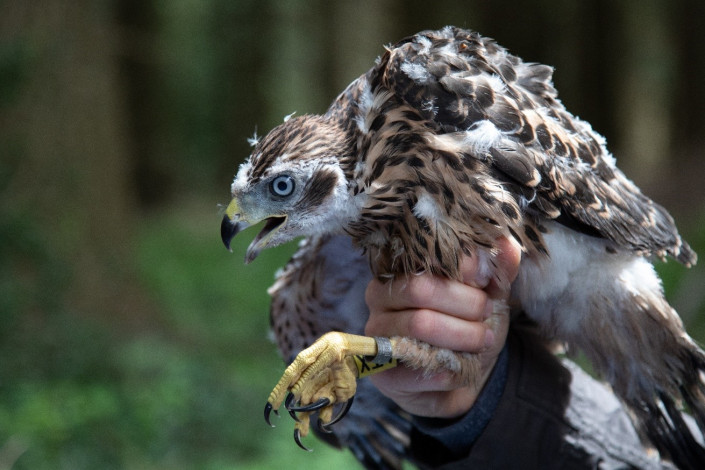
On the weekend of June 15th 2019, we were joined by Drs Ian Henderson and Greg Conway of the BTO to fit satellite tags to some of our young Goshawks both east and west of the Severn. We were delighted to get permission to do this; this is the first satellite tagging project in the county and will provide a glimpse into the secret life of the Goshawk. This is a licensed activity and highly regulated; to get to this stage we have had to apply to an independent panel who hear all the evidence and decide whether we can go ahead.

G1
Photo: Ben Locke

It’s important that the birds are of the right age, weight and size otherwise a tag will not be fitted; the birds’ welfare is absolutely paramount and no chances will be taken.

G2
Photo: Ben Locke

The process is to fit a ribbon harness which fits around the chest of the bird. The tag itself is either 18 grams for a male or 21 grams for a female and this sits on the back of the bird, it also contains a solar panel to charge the on-board battery and a “mobile phone”.
The device transmits the location of the bird, temperature, height, acceleration, direction of travel, battery level, temperature and a few other parameters.

G3
Photo: Ben Locke

Once the tags were fitted there is a tense wait; no information is transmitted as the tags need to charge and register but also the birds are often under cover. But it wasn’t long before we started to receive data…
Males were the first to explore but females are now moving around and the greatest distance moved so far (early September) is a female at around 18km from her nest site.

Some of the birds have gone into farmland and have often used hedgerows to roost or rest, even old hedgerows that have mainly been scrubbed out.

A couple of birds hopped briefly into Wales but only for day trips and moved back quickly.

Some birds have stayed in a tight area – not near their maternal home but they seem to have found an area where there must be food and cover.

One bird is of particular interest, a female who has visited nest sites of other Goshawks. We know it happens in breeding birds because if a pair go missing they are often quickly replaced by a new pair, who seem to be able to find old nests and use them the following year, but it is amazing to see that even at this age they seem to know what makes an ideal nesting area for Goshawks.

Some have come very close to conurbations but not flown directly over them, choosing to move along the edge and crossing a less built-up area.

G4

We have lost two birds at a very early stage, one of the tags has been retrieved and the bird will be sent off for a Post Mortem but there are no signs that the tag played a part in its death. Hopefully we can use the recovered tag next year, the other we are yet to look for. It’s a hard life for a Goshawk and it’s thought up to 60% of birds fail to reach maturity so this is to be expected. We know from our site visits and ringing this year that the weather was not conducive to a good breeding season – birds that went down on eggs early often failed as we had a warm spell but then a very wet, cold and windy spell which would have made hunting hard. The good news is that if the birds that went down later survived the early weeks they had plenty of food available.

As you will see some paths have crossed over each other but as far as I can tell looking at the data the birds were not in the same place at the same time. Not being very scientific a little piece of me would like them to meet although I suspect the consequences of meeting other Goshawks at this stage could be serious for a young bird.

G5
Photo: Semi-fledged Goshawk by Piers Suckling

It’s fantastic to look at these birds’ tracks on Google Maps etc but the real information is in the data and we hope to better understand this as the project goes on.

We are still to retrieve most of our nest cams but hopefully we will during the next couple of weeks and we are crossing fingers that that yields a photo of our first colour ringed bird.

A note about food sources: nest cams that have been retrieved over the last couple of years show squirrel is an important food source which will please foresters. It will be interesting to see if this changes for Goshawks based in the west of the county with the introduction of Pine Martens, I personally doubt it but time will tell.

Southam & District Tawny Owl Project update

An update from Rich Harris:

The Southam & District Tawny Owl Project has just completed its 4th breeding season.

In 2015 we had 12 breeding pairs in our nest boxes, and this has increased gradually each year so that we now have 27 breeding pairs this season.

The take-up of available boxes is an amazing 36% in 2019; the significant increase this year has been helped by a mild winter and an abundance of prey, especially the Long-tailed Field Mouse (aka Wood Mouse) which has been ever present at breeding sites.

Tawnies have taken to their new homes with gusto in coniferous plantains and mixed woodland where there is a lack of natural tree holes, and all the woods within the project, bar one, have maintained or increased the number of breeding pairs.

However, in ancient, mature woodland with ample natural nest sites, the uptake has been, since the project’s inception, a total blank even though it is clear while we are surveying that owls are present. Therefore I have decided to remove some boxes for repair and relocation to some new areas, and also to places in near to developing strongholds, building on past years successes.

We used a policy of placing boxes in pairs, 100 yards apart – in theory, one box for the breeding site and a second for the roosting male. The outcome has been interesting; either a second pair has taken up residence in the second box or other wildlife have moved in. Only on 3 occasions in 4 years has a male been flushed from the second box. The Tawny Owl is territorial, but seems to be able to tolerate other pairs nesting close by! So this policy has been abandoned going forward.

The positioning of boxes on the edge of woods rather than the interior has been helpful, enabling a passing owl to better identify a possible nest site. Most are East facing which is warmer and drier for the inhabitants and reduces wear and tear on the exposed box.

Although there are many reports of Tawny Owls moving into urban areas the 5 boxes in semi-urban locations have never been taken up; these will also be relocated.